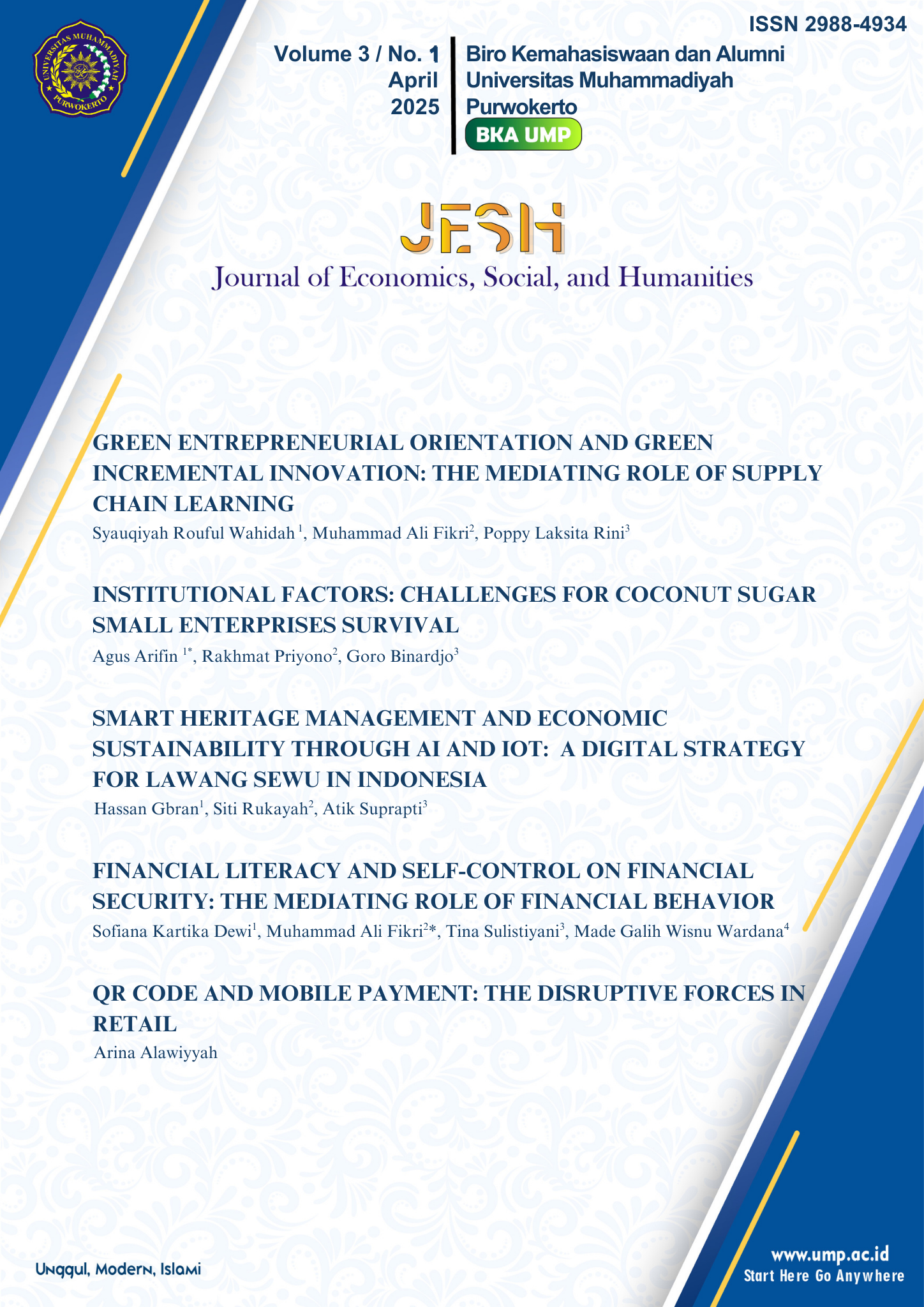
Green Entrepreneurial Orientation and Green Incremental Innovation: The Mediating Role of Supply Chain Learning
DOI:
https://doi.org/10.30595/jesh.v3i1.322Keywords:
Green Entrepreneurial Orientation, Supply Chain Learning, Green Incremental InnovationAbstract
The concept of green entrepreneurial orientation combines aspects of entrepreneurship and environmental sustainability, supporting supply chain learning and enhancing the flow of information related to green incremental innovation. The research aims to analyze the effect of green entrepreneurial orientation on green incremental innovation with mediation of supply chain learning. The sample of this study consists of 85 hotel employees in Yogyakarta, Indonesia. Data processing was conducted using Structural Equation Model-Partial Least Square version 4.0. This study shows that green entrepreneurial orientation has a positive effect on green incremental innovation, green entrepreneurial orientation positively influences supply chain learning, supply chain learning positively impacts green incremental innovation, and green entrepreneurial orientation positively affects green incremental innovation with supply chain learning as a mediator.
References
Alonso-Almeida, M. D. M., Rocafort, A., & Borrajo, F. (2016). Shedding light on eco-innovation in tourism: A critical analysis. Sustainability, 8(12), 1262.
Borghesi, S., Cainelli, G., & Mazzanti, M. (2015). Linking emission trading to environmental innovation: Evidence from the Italian manufacturing industry. Research Policy, 44(3), 669-683.
Castellacci, F., & Lie, C. M. (2017). A taxonomy of green innovators: Empirical evidence from South Korea. Journal of Cleaner Production, 143, 1036-1047.
Chen, Y. S., Chang, C. H., & Lin, Y. H. (2014). The determinants of green radical and incremental innovation performance: Green shared vision, green absorptive capacity, and green organizational ambidexterity. Sustainability, 6(11), 7787-7806.
Daft, R. L., & Samson, D. (2015). Fundamentals of Management: Asia Pacific Edition. Melbourne: Cengage Learning.
Dai, J., Cantor, D. E., & Montabon, F. L. (2015). How environmental management competitive pressure affects a focal firm's environmental innovation activities: a green supply chain perspective. Journal of Business Logistics, 36(3), 242-259.
Das, M., & Rangarajan, K. (2020). Impact of policy initiatives and collaborative synergy on sustainability and business growth of Indian SMEs. Indian Growth and Development Review, 13(3), 607-627.
Fernández-Mesa, A., & Alegre, J. (2015). Entrepreneurial orientation and export intensity: Examining the interplay of organizational learning and innovation. International business review, 24(1), 148-156.
Fussler, C., & James, P. (1996). Driving eco-innovation: A breakthrough discipline for innovation and sustainability. Pitman.
García-Pozo, A., Sánchez-Ollero, J. L., & Marchante-Lara, M. (2015). Eco-innovation and management: an empirical analysis of environmental good practices and labour productivity in the Spanish hotel industry. Innovation, 17(1), 58-68.
Guo, Y., Wang, L., Wang, M., & Zhang, X. (2019). The mediating role of environmental innovation on knowledge acquisition and corporate performance relationship—A study of SMEs in China. Sustainability, 11(8), 2315.
Guo, Y., Wang, L., & Xie, Y. (2018). Green innovation, green entrepreneurial orientation and supply chain learning: evidence from manufacturing firms in China. Preprints.
Hair, J. F., Astrachan, C. B., Moisescu, O. I., Radomir, L., Sarstedt, M., Vaithilingam, S., & Ringle, C. M. (2021). Executing and interpreting applications of PLS-SEM: Updates for family business researchers. Journal of Family Business Strategy, 12(3), 100392.
Hugo, E. M., & Nuringsih, K. (2020). Entrepreneurial Education, Green Orientation Entrepreneur, dan Green Value terhadap Ecology Entrepreneurial Intention. Jurnal Manajerial Dan Kewirausahaan, 2(4), 914-924.
Huo, B., Haq, M. Z. U., & Gu, M. (2021). The impact of information sharing on supply chain learning and flexibility performance. International Journal of Production Research, 59(5), 1411-1434.
Jer, R., Kim, D., & Bello, D. C. (2017). Relationship-based product innovations: Evidence from the global supply chain. Journal of Business Research, 80, 127-140.
Jiang, W., Chai, H., Shao, J., & Feng, T. (2018). Green entrepreneurial orientation for enhancing firm performance: A dynamic capability perspective. Journal of cleaner production, 198, 1311-1323.
Kothari, A., Hovanec, N., Hastie, R., & Sibbald, S. (2011). Lessons from the business sector for successful knowledge management in health care: a systematic review. BMC health services research, 11, 1-11.
Kolawole, I. O., Mbaiwa, J. E., & Mmopelwa, G. (2016). The environmental impacts of tourism on community people’s quality of life in Maun, Botswana. African Journal of Hospitality, Tourism and Leisure, 5(4), 1-14.
Leonidou, L. C., Christodoulides, P., Kyrgidou, L. P., & Palihawadana, D. (2017). Internal drivers and performance consequences of small firm green business strategy: The moderating role of external forces. Journal of business ethics, 140, 585-606.
Li, L., Jiang, F., Pei, Y., & Jiang, N. (2017). Entrepreneurial orientation and strategic alliance success: The contingency role of relational factors. Journal of Business Research, 72, 46-56.
Martínez-Pérez, B., De La Torre-Díez, I., & López-Coronado, M. (2015). Privacy and security in mobile health apps: a review and recommendations. Journal of medical systems, 39, 1-8.
Migdadi, M. M. (2022). Impact of knowledge management processes on organizational performance: the mediating role of absorptive capacity. Business Process Management Journal, 28(1), 293-322.
Muangmee, C., Dacko-Pikiewicz, Z., Meekaewkunchorn, N., Kassakorn, N., & Khalid, B. (2021). Green entrepreneurial orientation and green innovation in small and medium-sized enterprises (SMEs). Social Sciences, 10(4), 136.
Nilashi, M., Rupani, P. F., Rupani, M. M., Kamyab, H., Shao, W., Ahmadi, H., & Aljojo, N. (2019). Measuring sustainability through ecological sustainability and human sustainability: A machine learning approach. Journal of Cleaner Production, 240, 118162.
Pan, S., Tian, H., Dangal, S. R., Ouyang, Z., Tao, B., Ren, W.,& Running, S. (2014). Modeling and monitoring terrestrial primary production in a changing global environment: toward a multiscale synthesis of observation and simulation. Advances in Meteorology, 2014(1), 965936.
Pramanik, P. D., & Ingkadijaya, R. (2018, April). The impact of tourism on village society and its environmental. In IOP Conference Series: Earth and Environmental Science (Vol. 145, No. 1, p. 012060). IOP Publishing.
Pratono, A. H., Darmasetiawan, N. K., Yudiarso, A., & Jeong, B. G. (2019). Achieving sustainable competitive advantage through green entrepreneurial orientation and market orientation: The role of inter-organizational learning. The Bottom Line, 32(1), 2-15.
Shan, P., Song, M., & Ju, X. (2016). Entrepreneurial orientation and performance: Is innovation speed a missing link?. Journal of business research, 69(2), 683-690.
Tamayo-Orbegozo, U., Vicente-Molina, M. A., & Villarreal-Larrinaga, O. (2017). Eco-innovation strategic model. A multiple-case study from a highly eco-innovative European region. Journal of Cleaner Production, 142, 1347-1367.
Teece, D.J., Pisano, G. and Shuen, A. (1997), “Dynamic capabilities and strategic management”, Strategic Management Journal, Vol. 18, p. 509-33.
Teng, B. S. (2007). Corporate entrepreneurship activities through strategic alliances: A resource‐based approach toward competitive advantage. Journal of Management studies, 44(1), 119-142.
Xie, X., Huo, J., & Zou, H. (2019). Green process innovation, green product innovation, and corporate financial performance: A content analysis method. Journal of business research, 101, 697-706.
Ying, F., Tookey, J., & Seadon, J. (2018). Measuring the invisible: A key performance indicator for managing construction logistics performance. Benchmarking: an international journal, 25(6), 1921-1934.
Zeng, D., Hu, J., & Ouyang, T. (2017). Managing innovation paradox in the sustainable innovation ecosystem: A case study of ambidextrous capability in a focal firm. Sustainability, 9(11), 2091.
Zhu, Q., Krikke, H., & Caniëls, M. C. (2018). Supply chain integration: value creation through managing inter-organizational learning. International journal of operations & production management, 38(1), 211-229
Downloads
Published
How to Cite
Issue
Section
License
Copyright (c) 2025 Syauqiyah Rouful Wahidah , Muhammad Ali Fikri, Poppy Laksita Rini

This work is licensed under a Creative Commons Attribution-NonCommercial 4.0 International License.
Authors who publish with this journal agree to the following terms:
Authors retain copyright and grant the journal right of first publication with the work simultaneously licensed under a Creative Commons Attribution License that allows others to share the work with an acknowledgement of the work's authorship and initial publication in this journal.
Authors are able to enter into separate, additional contractual arrangements for the non-exclusive distribution of the journal's published version of the work (e.g., post it to an institutional repository or publish it in a book), with an acknowledgement of its initial publication in this journal.
Authors are permitted and encouraged to post their work online (e.g., in institutional repositories or on their website) prior to and during the submission process, as it can lead to productive exchanges, as well as earlier and greater citation of published work (See The Effect of Open Access).

Journal of Social, Economics, and Humanities is licensed under a Creative Commons Attribution 4.0 International License.