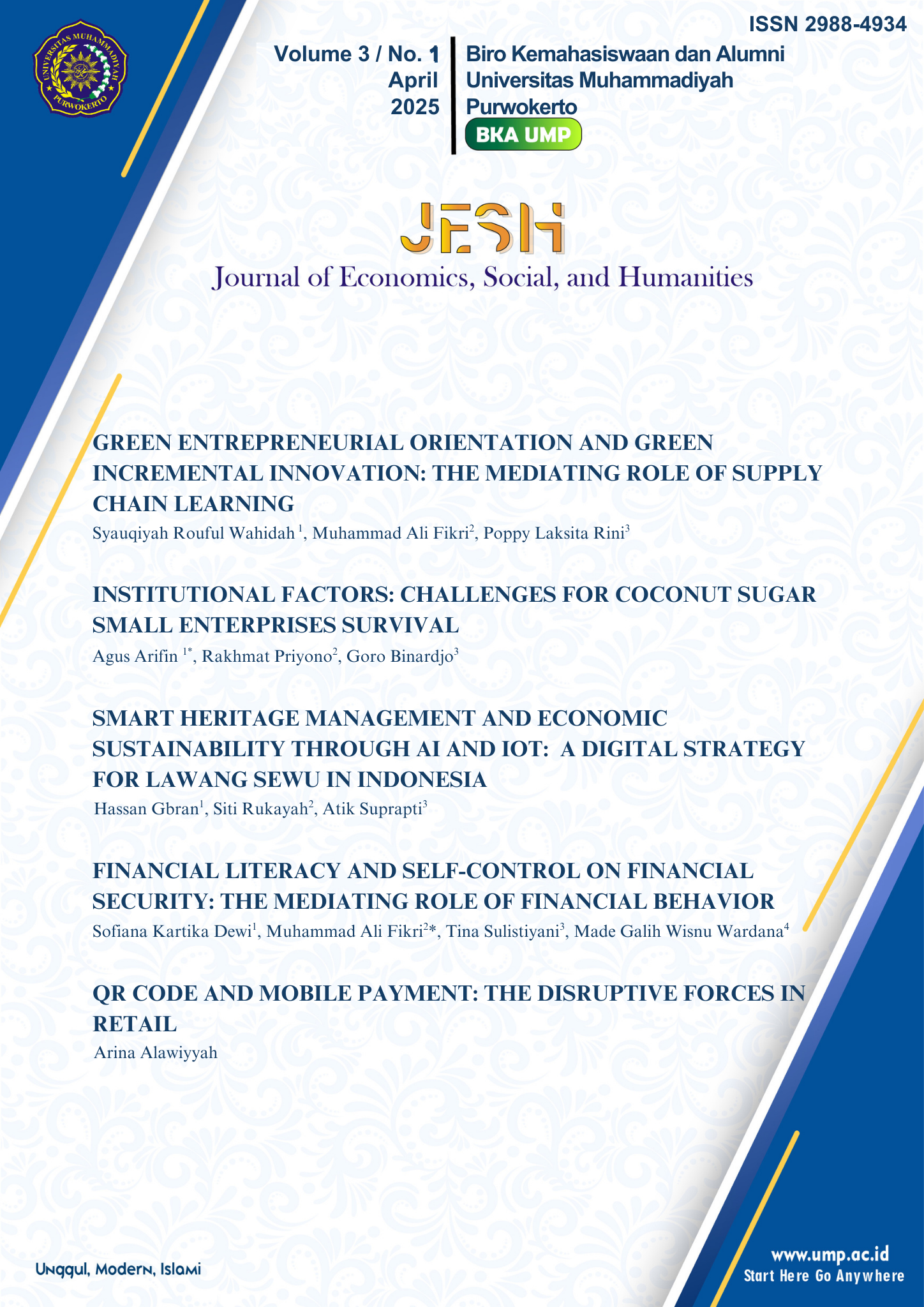
QR Code and Mobile Payment: The Disruptive Forces in Retail
DOI:
https://doi.org/10.30595/jesh.v3i1.319Keywords:
M-payment, QR Code, MTAM, Behavioral Intention, Mobile UsefulnessAbstract
Penelitian ini bertujuan untuk menganalisis faktor-faktor yang memengaruhi adopsi mobile payment (m-payment) berbasis Quick Response (QR) Code pada karyawan yayasan pondok pesantren Al-Hikmah 1 Brebes yang menggunakan Qr Code sebagai alat transaksi. Menggunakan Mobile Technology Acceptance Model (MTAM) yang diperluas. Fokus penelitian ini adalah mengevaluasi pengaruh Optimism, Personal Innovativeness, dan Mobile Usefulness sebagai variabel mediasi terhadap Behavioral Intention dalam mengadopsi m-payment. Penelitian ini menggunakan metode kuantitatif dengan data primer yang diperoleh melalui penyebaran kuesioner secara online menggunakan Google Form. Populasi penelitian ini yaitu karyawan di Yayasan pondok pesantren Al-hikmah 1 yang berjumlah 350 Karyawan dengan Sampel yang diguanakan berjumlah 60, alat analisis SMART PLS 3 untuk menguji hubungan antar variabel. Hasil penelitian menunjukkan bahwa Optimism (X1) dan Personal Innovativeness (X2) tidak berpengaruh signifikan langsung terhadap Behavioral Intention (Y), tetapi Mobile Usefulness (M) memiliki pengaruh signifikan terhadap Y. Selain itu, X1 dan X2 berpengaruh signifikan terhadap M dan Y melalui M sebagai mediasi. Hasil ini menunjukkan pentingnya peran Mobile Usefulness dalam meningkatkan niat adopsi m-payment. Implikasi penelitian ini meliputi penguatan edukasi pengguna, pengembangan teknologi yang user-friendly, dan peningkatan infrastruktur untuk mendorong adopsi m-payment di Indonesia.
References
Alghazi, S. S., Kamsin, A., Almaiah, M. A., Wong, S. Y., & Shuib, L. (2021). For sustainable application of mobile learning: An extended UTAUT model to examine the effect of technical factors on the usage of mobile devices as a learning tool. Sustainability, 13(4), 1856.
Al-Hawary, S. I. S., & Obiadat, A. A. (2021). Does mobile marketing affect customer loyalty in Jordan?. International Journal of Business Excellence, 23(2), 226-250.
Ali, I. (2019). Personality traits, individual innovativeness and satisfaction with life. Journal of Innovation & knowledge, 4(1), 38-46.
Ardhana, A., & Usman, B. (2024). Implementasi Pengujian Model Tam Pada Aplikasi Qris Merchant: Studi Empiris Di Kota Bengkulu. JMBI UNSRAT (Jurnal Ilmiah Manajemen Bisnis dan Inovasi Universitas Sam Ratulangi)., 11(1), 416-429.
Atmaja, Y. S., & Paulus, D. H. (2022). Partisipasi Bank Indonesia Dalam Pengaturan Digitalisasi Sistem Pembayaran Indonesia. Masalah-Masalah Hukum, 51(3), 271-286.
Bouzari, M., & Karatepe, O. M. (2020). Does optimism mediate the influence of work-life balance on hotel salespeople’s life satisfaction and creative performance?. Journal of Human Resources in Hospitality & Tourism, 19(1), 82-101.
Erul, E., Woosnam, K. M., & McIntosh, W. A. (2020). Considering emotional solidarity and the theory of planned behavior in explaining behavioral intentions to support tourism development. Journal of Sustainable Tourism, 28(8), 1158-1173.
Hartanto, H., Rosadi, V., & Yosmar, E. A. (2023). Perlindungan Hukum Terhadap Pengguna Aplikasi E-Wallet Dana. PATTIMURA Legal Journal, 2(3), 267-279.
Indonesia.go.id. (2024). Transaksi Digital Tumbuh Pesat. Diakses https://indonesia.go.id/kategori/editorial/8279/transaksi-digital-tumbuh-pesat?lang=1
Jumaan, I. A., Hashim, N. H., & Al-Ghazali, B. M. (2020). The role of cognitive absorption in predicting mobile internet users’ continuance intention: An extension of the expectation-confirmation model. Technology in Society, 63, 101355.
Kresnanto, N. C., Putri, W. H., & Tiyas, H. (2020). Integrasi UTAUT dan SCT dalam Penggunaan Mobile Payment Pada Jasa Transportasi Publik. Efektif Jurnal Ekonomi dan Bisnis, 11(2), 91-106.
Mawaddah, N. K., & Retnowardhani, A. (2023). User Technology Readiness and Acceptance of Mobile Human Resources Information Application. INFORMAL: Informatics Journal, 8(1), 30-36.
Nguyen-Tan, L., & Le-Hoang, P. V. (2024). Personal Innovation, Optimism, Electronic Word of Mouth, and Perceived Factors Affect the Behavioral Intention to Adopt QR Code Payments. Review of Marketing Science, (0).
Putit, L., & Sahudin, Z. (2023). Towards adopting innovative quick response (QR)-enabled contactless transaction payment: the Malaysian MSMES’entrepreneurial perspective in COVID-19 setting. In Open Innovation in Small Business: Creating Values for Sustainability (pp. 57-70). Singapore: Springer Nature Singapore.
Rafdinal, W., & Senalasari, W. (2021). Predicting the adoption of mobile payment applications during the COVID-19 pandemic. International Journal of Bank Marketing, 39(6), 984-1002.
Saputra, Y. F. E., & Bahari, A. (2024). Analisis Determinan Dan Anteseden Penggunaan Quick Response Indonesian Standard (QRIS) Pada Pembayaran Digital. Management Studies and Entrepreneurship Journal (MSEJ), 5(1), 3026-3037.
Sehat, N. S., Daud, S. R., Ahmad, K. S., Suhaime, I. L., & Jogeran, J. (2024). Acceptance Factors Affecting the Intention to Use Mobile Payments: QR Code Applications. Information Management and Business Review, 16(1 (I)), 287-304.
Sodik, F., & Riza, A. F. (2023). Potensi QRIS M-banking Bank Syariah sebagai Teknologi Pembayaran untuk Mendukung Inklusi Keuangan Syariah di Indonesia. Jurnal Ekonomi Indonesia, 12(2), 125-154.
Suo, W. J., Goi, C. L., Goi, M. T., & Sim, A. K. (2022). Factors influencing behavioural intention to adopt the QR-code payment: Extending UTAUT2 model. International Journal of Asian Business and Information Management (IJABIM), 13(2), 1-22.
Tu, M., Wu, L., Wan, H., Ding, Z., Guo, Z., & Chen, J. (2022). The adoption of QR code mobile payment technology during COVID-19: A social learning perspective. Frontiers in Psychology, 12, 798199.
Ustadi, M. N., & Mat, C. R. C. (2023). The Evolution of Theory of Reasoned Action (TRA) and Theory of Planned Behavior (TPB) To Predict Whether a Person Intends to Do Something, Researchers Need to Know:• Whether the Person Is in Favor of Doing It ('attitude’)• How Much the Person Feels Socially Pressured to Do It ('subjective Norm’). Technologies and Trends in the Halal Industry.
Wardani, V. K., Wardoyo, C., & Wulandari, D. (2024). Investigasi variabel-variabel yang memengaruhi minat penggunaan QRIS oleh mahasiswa: financial literacy sebagai variabel moderasi. Jurnal Ilmu Manajemen, 451-468.
Wu, W., & Yu, L. (2022). How does personal innovativeness in the domain of information technology promote knowledge workers’ innovative work behavior?. Information & Management, 59(6), 103688.
Yamin, M. A. Y., & Abdalatif, O. A. A. (2024). Examining consumer behavior towards adoption of quick response code mobile payment systems: transforming mobile payment in the fintech industry. Humanities and Social Sciences Communications, 11(1), 1-11.
Zakiyyah, A. M., Fadah, I., Paramu, H., & Awwaliyah, I. N. (2023). Literasi (Keuangan, Informasi Digital dan Keuangan Digital). UM Jember Press
Downloads
Published
How to Cite
Issue
Section
License
Copyright (c) 2025 EditorJESHUMP

This work is licensed under a Creative Commons Attribution-NonCommercial 4.0 International License.
Authors who publish with this journal agree to the following terms:
Authors retain copyright and grant the journal right of first publication with the work simultaneously licensed under a Creative Commons Attribution License that allows others to share the work with an acknowledgement of the work's authorship and initial publication in this journal.
Authors are able to enter into separate, additional contractual arrangements for the non-exclusive distribution of the journal's published version of the work (e.g., post it to an institutional repository or publish it in a book), with an acknowledgement of its initial publication in this journal.
Authors are permitted and encouraged to post their work online (e.g., in institutional repositories or on their website) prior to and during the submission process, as it can lead to productive exchanges, as well as earlier and greater citation of published work (See The Effect of Open Access).

Journal of Social, Economics, and Humanities is licensed under a Creative Commons Attribution 4.0 International License.