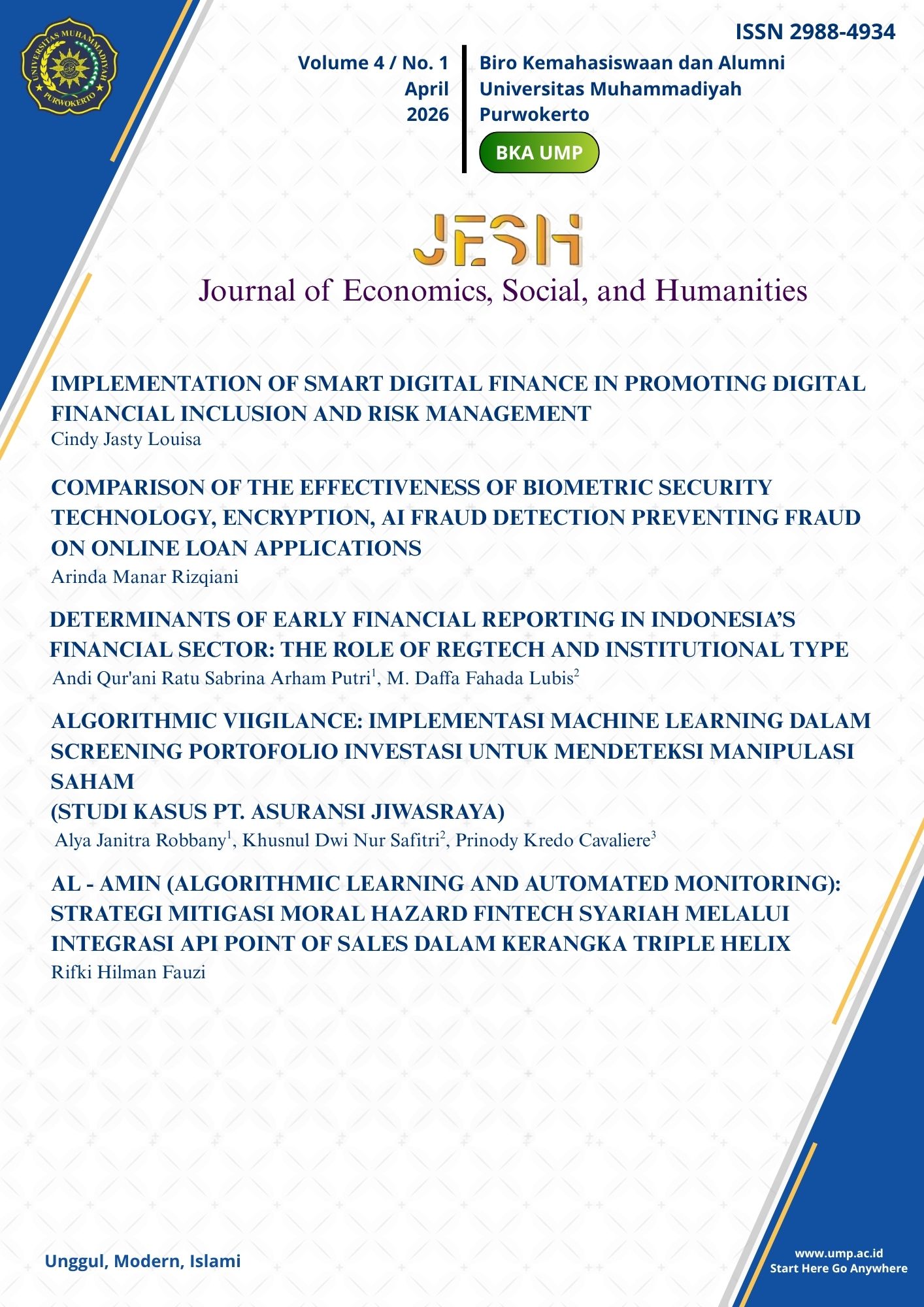
Implementation of Smart Digital Finance in Promoting Digital Financial Inclusion and Risk Management
DOI:
https://doi.org/10.30595/jesh.v4i1.463Keywords:
Smart Digital Finance, Digital Financial Inclusion, Digital Payment Systems, Trust, Security, Financial GovernanceAbstract
The development of digital finance has transformed financial systems in developing countries by enhancing efficiency, accessibility, and transparency, while simultaneously introducing new technological and institutional risks. This study analyzes the implementation of Smart Digital Finance in Indonesia and its role in promoting digital financial inclusion through the management of technological, trust, and security aspects. The study adopts a qualitative descriptive–analytical approach by systematically reviewing policy documents, institutional reports, and relevant academic literature.
The findings indicate that the development of interoperable digital payment infrastructure, particularly through QR-based payment systems, has expanded public access to formal financial services, improved operational efficiency through the utilization of digital transaction data, and supported the integration of micro and small enterprises into the formal economic system. Nevertheless, cybersecurity risks, personal data protection issues, digital fraud, and public trust remain major challenges to the sustainability of the digital financial system.
Therefore, this study emphasizes the importance of risk-sensitive regulation, strong consumer protection, secure digital identity systems, and effective institutional governance to ensure that Smart Digital Finance can promote inclusive economic growth and sustainable public financial governance in Indonesia.
References
Aker, J. C., Boumnijel, R., McClelland, A., & Tierney, N. (2016). Payment mechanisms and anti-poverty programs: Evidence from a mobile money cash transfer experiment in Niger.
Economic Development and Cultural Change, 65(1), 1–37.
Brune, L., Giné, X., Goldberg, J., & Yang, D. (2016). Facilitating savings for agriculture: Evidence from Malawi. Economic Development and Cultural Change, 64(2), 187–220. Demirgüç-Kunt, A., Klapper, L., Singer, D., & Van Oudheusden, P. (2015). The Global Findex
Database 2014: Measuring financial inclusion around the world. World Bank Policy Research Working Paper No. 7255.
Evans, D. S., & Pirchio, A. (2015). An empirical examination of why mobile money schemes ignite in some developing countries but flounder in most. Review of Network Economics, 13(4), 397–451.
GSMA Intelligence. (2016). The Mobile Economy 2016. GSMA. IFC & SME Finance Forum. (2013). Enterprise finance gap database. International Finance Corporation.
IMF. (2015). Financial deepening and economic growth in developing countries. International Monetary Fund Staff Discussion Note.
Rogoff, K. (2016). The curse of cash. Princeton University Press.
Voorhies, R., Roth, J., & Schneider, R. (2013). State of the industry: Results from the 2013 global survey on mobile financial services for the unbanked. GSMA Mobile Money for the Unbanked.
World Bank. (2018). ID4D digital identification for development. World Bank Group.
Downloads
Published
How to Cite
Issue
Section
License
Copyright (c) 2026 Cindy Jasty Louisa

This work is licensed under a Creative Commons Attribution 4.0 International License.
Authors who publish with this journal agree to the following terms:
Authors retain copyright and grant the journal right of first publication with the work simultaneously licensed under a Creative Commons Attribution License that allows others to share the work with an acknowledgement of the work's authorship and initial publication in this journal.
Authors are able to enter into separate, additional contractual arrangements for the non-exclusive distribution of the journal's published version of the work (e.g., post it to an institutional repository or publish it in a book), with an acknowledgement of its initial publication in this journal.
Authors are permitted and encouraged to post their work online (e.g., in institutional repositories or on their website) prior to and during the submission process, as it can lead to productive exchanges, as well as earlier and greater citation of published work (See The Effect of Open Access).

Journal of Social, Economics, and Humanities is licensed under a Creative Commons Attribution 4.0 International License.