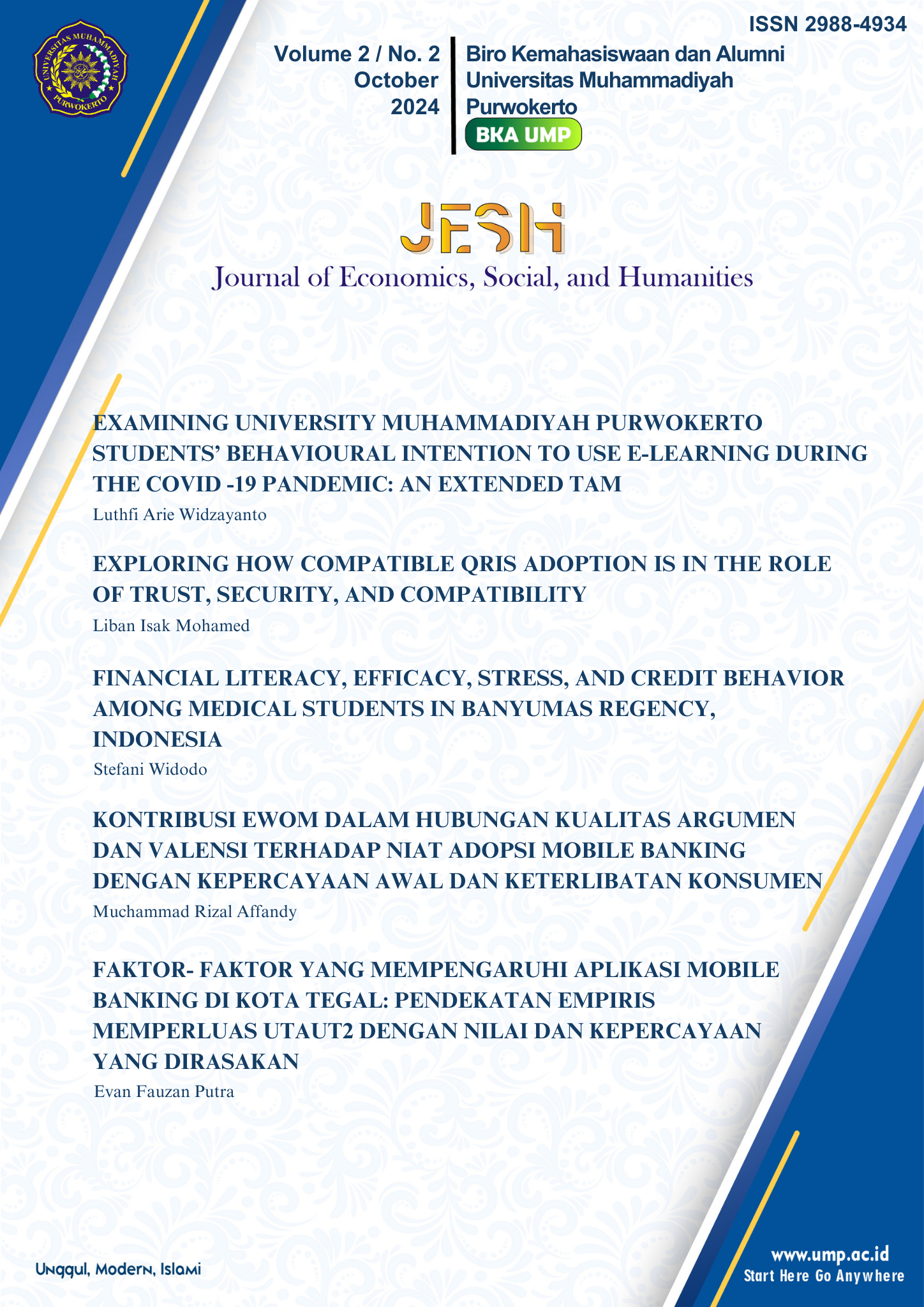
Kontribusi eWOM dalam Hubungan Kualitas Argumen dan Valensi terhadap Niat Adopsi Mobile Banking dengan Kepercayaan Awal dan Keterlibatan Konsumen
DOI:
https://doi.org/10.30595/jesh.v2i2.314Keywords:
eWOM, Niat Adopsi, Mobile BankingAbstract
Penelitian ini bertujuan untuk mengeksplorasi kontribusi electronic Word of Mouth (eWOM) terhadap hubungan antara kualitas argumen dan valensi dengan niat adopsi mobile banking, serta peran kepercayaan awal dan keterlibatan konsumen. Studi ini menggunakan pendekatan kuantitatif dengan menyebarkan kuesioner kepada 60 responden yang bekerja di PT Yosa Dyos Jaya Cilacap. Teknik analisis data dilakukan menggunakan PLS-SEM dengan software SmartPLS. Hasil penelitian menunjukkan bahwa kualitas argumen memiliki pengaruh signifikan terhadap keterlibatan konsumen, sedangkan valensi eWOM memiliki hubungan positif signifikan dengan niat adopsi mobile banking. Selain itu, volume ulasan juga menunjukkan pengaruh signifikan terhadap niat adopsi. Penelitian ini menegaskan pentingnya eWOM positif dalam mendorong kepercayaan dan niat konsumen untuk mengadopsi teknologi mobile banking. Hasil ini memberikan implikasi praktis bagi bank untuk meningkatkan kualitas layanan dan mendorong ulasan positif dari pengguna melalui platform digital.
References
Abdullah, M. (2015). Metode Penelitian Kuantitatif. Aswaja Pressindo Yogyakarta.
Akturan, U., & Tezcan, N. (2012). Mobile banking adoption of the youth market: Perceptions and intentions. Marketing Intelligence and Planning, 30(4), 444–459. https://doi.org/10.1108/02634501211231928
Asmuni, A., Harahap, I., & Saragih, L. M. S. (2021). Carter Dimension Analysis of Customer Satisfaction In Improving Electronic Word Of Mouth (E-Wom) In Bank Syariah Mandiri Customers. International Journal of Artificial Intelligence Research, 6(1). https://doi.org/10.29099/ijair.v6i1.293
Aswania. (2020). TINGKAT PEMAHAMAN NASABAH TERHADAP M-BANKING (MOBILE BANKING) BSI DI KOTA RAHA. Perbankan Syariah, 6.
blessa, victoria andrenita, & inriani, farida. (2022). Analisis Pengaruh Kepercayaan, Keterlibatan Konsumen, DanKualitas Produk Serta Dampaknya Terhadap KeputusanPembelian Produk Melalui Shopee Live. Diponegoro Journal of Management, 11, 1–11.
Hennig-Thurau, T., Gwinner, K. P., Walsh, G., & Gremler, D. D. (2004). Electronic word-of-mouth via consumer-opinion platforms: What motivates consumers to articulate themselves on the Internet? Journal of Interactive Marketing, 18(1), 38–52. https://doi.org/10.1002/dir.10073
Hidayat DK. (2020). Hubungan antara Tingkat Electronic. Word of Mouth (e-WOM) terhadap Tingkat e-trust pada pengguna Aplikasi Digital Perbankan. Galang Tanjung, 2504, 1–9.
Kamtarin, M. (2012). The Effect of Electronic Word of Mouth, Trust and Perceived Value on Behavioral Intention from the Perspective of Consumers. International Journal of Academic Research in Economics and Management Sciences.
Liu, J., Kang, M., & Haile, T. T. (2021). Argument quality and review adoption: Interaction effect of product and review type. Asian Journal of Business Research, 11(2), 22–42. https://doi.org/10.14707/ajbr.210105
Maulana, R., Iskandar, I., & Mailany, M. (2019). Pengaruh Penggunaan Mobile Banking Terhadap Minat Nasabah Dalam Bertransaksi Menggunakan Technology Acceptance Model. Cyberspace: Jurnal Pendidikan Teknologi Informasi, 2(2), 146. https://doi.org/10.22373/cj.v2i2.4161
Nasution, R. A., Fauzi, A., & Lubis, A. N. (2023). The Effect of Customer Co-creation on eWOM through Customer Satisfaction. Proceeding Medan International Conference Economics and Business, 1(January), 1050–1057.
Nur, F. R., Hadi, N., & Citradewi, A. (2023). Faktor-Faktor yang Mempengaruhi Niat Adopsi Mobile Banking Bank Syariah Indonesia di Kabupaten Kudus. Al-Intaj : Jurnal Ekonomi Dan Perbankan Syariah, 9(2), 162. https://doi.org/10.29300/aij.v9i2.11129
Rahmah, R. M., & Supriyono, S. (2022). Jurnal Bisnis dan Kajian Strategi Manajemen Pengaruh Electronic Word Of Mouth Dan Citra Merek Terhadap Keputusan Pembelian Masker Wajah Sariayu Jurnal Bisnis dan Kajian Strategi Manajemen. Jurnal Bisnis Dan Kajian Strategi Manajemen, 6(2), 161–169.
Riayu Putri Annisaa’ & Susanto Romi. (2021). Penerapan M-Banking Dalam Meningkatkan Jasa Dan Layanan Perbankan Di PT. Bank Pembangunan Daerah Sumatera Barat Cabang Siteba. Nuevos Sistemas de Comunicación e Información, 2013–2015.
Sari, P., & Rifaldi Windya Giri, R. (2023). Pengaruh Electronic Word of Mouth Terhadap Niat Adopsi Mobile Banking Menggunakan Elaboration Likelihood Model (ELM). Journal of Economics and Business UBS, 12(3), 1913–1928. https://doi.org/10.52644/joeb.v12i3.282
Shankar, A., Jebarajakirthy, C., & Ashaduzzaman, M. (2020). How do electronic word of mouth practices contribute to mobile banking adoption? Journal of Retailing and Consumer Services, 52(June 2019), 101920. https://doi.org/10.1016/j.jretconser.2019.101920
Shankar A, J. C. (2019). Pengaruh kualitas layanan e-banking terhadap loyalitas nasabah: pendekatan mediasi yang dimoderasi. Bank Mark, 37(5), 1119–1142.
Sitorus, H.M., Govindaraju, R., Wiratmadja, I. I., & & Sudirman, I. (2019). Examining the Role of Usability, Compatibility and Social Influence in Mobile Banking Adoption in Indonesia. Journal of Technology, 10(2), 351-362.
Zhang, J. Q., Craciun, G., & Shin, D. (2010). When does electronic word-of-mouth matter? A study of consumer product reviews. Journal of Business Research, 63(12), 1336–1341. https://doi.org/10.1016/j.jbusres.2009.12.011
Downloads
Published
How to Cite
Issue
Section
License
Copyright (c) 2024 Suryo Edi, EditorJESHUMP

This work is licensed under a Creative Commons Attribution-NonCommercial 4.0 International License.
Authors who publish with this journal agree to the following terms:
Authors retain copyright and grant the journal right of first publication with the work simultaneously licensed under a Creative Commons Attribution License that allows others to share the work with an acknowledgement of the work's authorship and initial publication in this journal.
Authors are able to enter into separate, additional contractual arrangements for the non-exclusive distribution of the journal's published version of the work (e.g., post it to an institutional repository or publish it in a book), with an acknowledgement of its initial publication in this journal.
Authors are permitted and encouraged to post their work online (e.g., in institutional repositories or on their website) prior to and during the submission process, as it can lead to productive exchanges, as well as earlier and greater citation of published work (See The Effect of Open Access).

Journal of Social, Economics, and Humanities is licensed under a Creative Commons Attribution 4.0 International License.