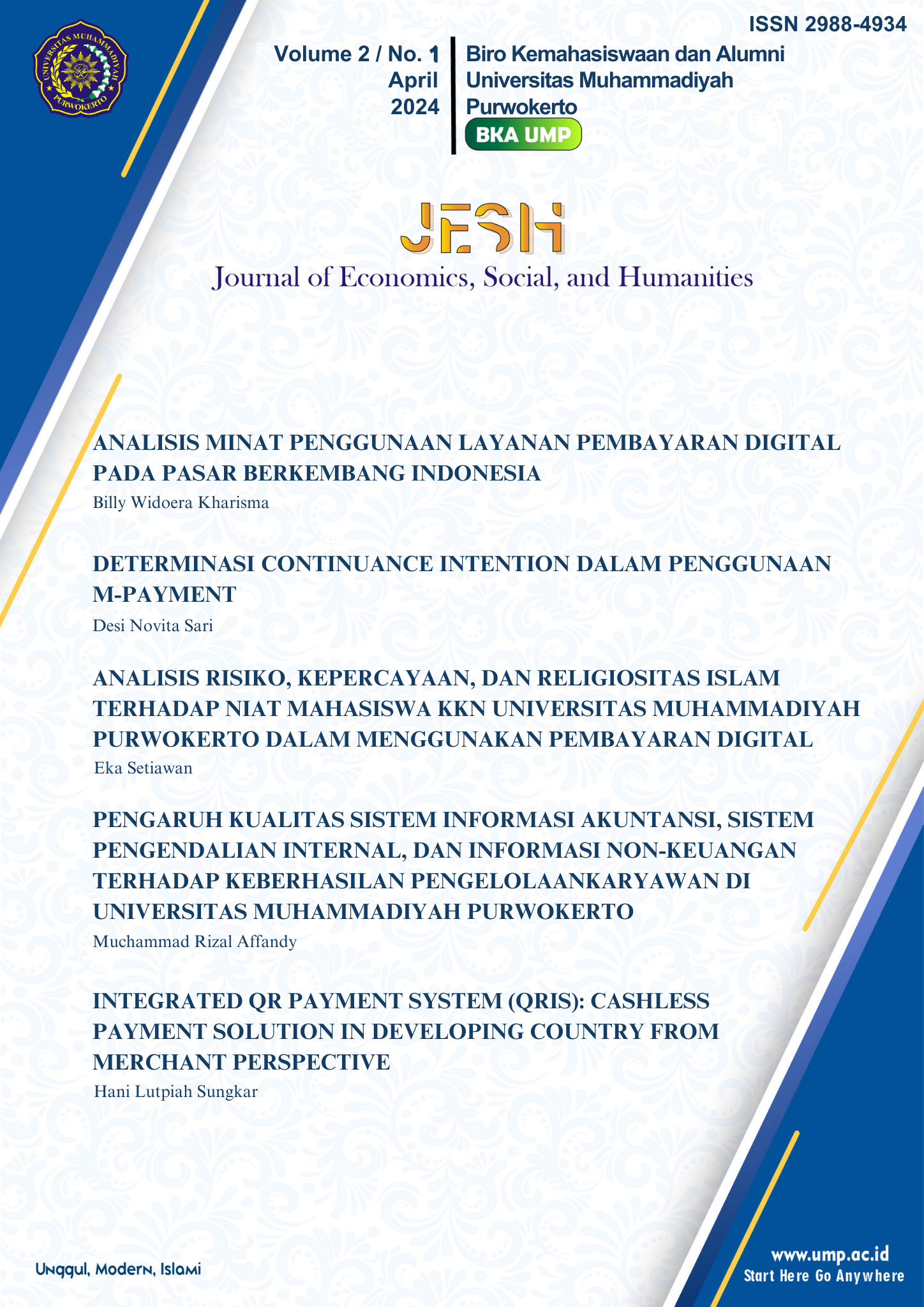
Integrated QR Payment System (QRIS): Cashless Payment Solution in Developing Country from Merchant Perspective
DOI:
https://doi.org/10.30595/jesh.v2i1.310Keywords:
Behavioeral Intention, Mobile Ease of Use, Perceived Security, Perceived Compatibility, Mobile UsefulnessAbstract
Penelitian ini bertujuan untuk menganalisis faktor-faktor yang mempengaruhi adopsi sistem pembayaran digital QRIS di Indonesia, dengan fokus pada tantangan yang dihadapi oleh merchant, terutama di sektor UMKM, serta peran regulasi pemerintah dalam mendukung inklusi keuangan. Metode yang digunakan adalah kuantitatif dengan penyebaran kuesioner kepada 60 responden yang dipilih menggunakan convenience sampling. Data dianalisis menggunakan SmartPLS. Hasil penelitian menunjukkan bahwa Mobile Ease of Use berpengaruh signifikan terhadap Mobile Usefulness, dan Perceived Security juga berpengaruh terhadap Mobile Usefulness. Namun, tidak ditemukan pengaruh signifikan antara variabel-variabel lainnya, seperti kemudahan penggunaan, kesesuaian, dan keamanan terhadap niat perilaku pengguna. Penelitian ini menyoroti pentingnya peningkatan kemudahan penggunaan dan keamanan dalam mempercepat adopsi QRIS di sektor UMKM.
References
Abbad, Muneer M. M. 2021. “Using the UTAUT Model to Understand Students ’ Usage of e-Learning Systems in Developing Countries.” Education and Information Technologies (0123456789). doi: 10.1007/s10639-021-10573-5.
Ali, Hapzi, Hamdan Hamdan, and M. Rizky Mahaputra. 2022. “Faktor Eksternal Perceived Ease of Use Dan Perceived Usefulness Pada Aplikasi Belanja Online: Adopsi Technology Accepted Model.” Jurnal Ilmu Multidisplin 1(3):587–604. doi: 10.38035/jim.v1i3.75.
Atieq, Muhamad Qoes, and Eva Nurpiani. 2022. “MINAT NASABAH MENGGUNAKAN MOBILE BANKING BANK SYARIAH ( Survey Pada Mahasiswa Perbankan Syariah IAIN Syekh Nurjati Cirebon ) PENDAHULUAN Perkembangan Teknologi Informasi Menciptakan Berbagai Peluang Bisnis Dimana Transaksi Yang Dilakukan Secara Elektronik.” Jurnal Valuasi : Jurnal Ilmiah Ilmu Manajemen Dan Kewirausahaan 2(1):401–23.
Belanche, Daniel, Marta Flavian, and Alferedo Rueda. 2020. “Mobile Apps Use and WOM in the Food Delivery Sector : The Role of Planned Behavior , Perceived Security and Customer Lifestyle Compatibility.” Sustainability (Switzerland) 12:4275.
Budiman, Yohanes Imanuel. 2022. “Pengaruh Perceived Usefulness Service Dan Sefl Efficacy Terhadap Intention Of Use Mobile Payment Fintech Di Jakarta.” Jurnal Manajemen Bisnis Dan Kewirausahaan 6(3):306–11.
Chao, Cheng-min. 2019. “Factors Determining the Behavioral Intention to Use Mobile Learning : An Application and Extension of the UTAUT Model.” Frontiers 10(July):1–14. doi: 10.3389/fpsyg.2019.01652.
Ciputra, William, and Wibawa Prasetya. 2020. “Analisis Pengaruh E-Service Quality, Perceived Value Terhadap Customer Satisfaction, Trust, Dan Customer Behavioral Intention.” COMMENTATE: Journal of Communication Management 1(2):109. doi: 10.37535/103001220201.
Daragmeh, Ahmad, Csaba Lentner, and Judit Sági. 2021. “FinTech Payments in the Era of COVID-19: Factors Influencing Behavioral Intentions of ‘Generation X’ in Hungary to Use Mobile Payment.” Journal of Behavioral and Experimental Finance 32:100574. doi: 10.1016/j.jbef.2021.100574.
Kamalia, Nur Faizatun NM, and Amma Fazizah. 2024. “Pengaruh Perceived Usefulness, Perceived Ease Of Use Dan Perceived Risk Terhadap Continue Intention To Use Melalui Kepuasan Pengguna Aplikasi Mobile Banking Bca.” Musytari: Neraca Manajemen, Ekonomi 8(6).
Kumar, Jeya Amantha, Brandford Bervell, Nagaletchimee Annamalai, and Sharifah Osman. 2020. “Behavioral Intention to Use Mobile Learning : Evaluating the Role of Self-Efficacy , Subjective Norm , and WhatsApp Use Habit.” Digital Object Identifier Journal 8.
Lu, Jin, and Fuangfa Amponstira. 2020. “The Impact of Perceived Destination Restorative Qualities on Chinese Tourists ’ Behavioral Intention After Visiting Thailand.” Journal Of Business Reasearch 12(2):1006–13.
Rachman, Abdul, Niken Julianti, and Siti Arkoyah. 2024. “Challenges and Opportunities for QRIS Implementation as a Digital Payment System in Indonesia.” EkBis: Jurnal Ekonomi Dan Bisnis 8(1):1–13. doi: 10.14421/EkBis.2024.8.1.2134.
Rafferty, Nathan Eleazar, and Ahmad Nurul Fajar. 2022. “Integrated QR Payment System (QRIS): Cashless Payment Solution in Developing Country from Merchant Perspective.” Asia Pacific Journal of Information Systems 32(3):630–55. doi: 10.14329/APJIS.2022.32.3.630.
Saputri, Prilyandari Dina. 2023. “The Digitalization Impact Of The Payment System Through Qris On East Java Regional Financial Transactions.” East Java Economic Journal 7(2):301–18. doi: 10.53572/ejavec.v7i2.120.
Sartini, Putu, I. Putu Dharmanu Yudharta, and Putu Eka Purnamaningsih. 2023. “Efektivitas Program SIAP ( Sehat , Inovatif , Aman , Pakai ) Quick Response Code Indonesian Standard ( QRIS ) Untuk Mendukung Inklusi Keuangan Digital Di Pasar Badung , Kota Denpasar.” BIREV: Business and Investment Review 1(3):195–210.
Sidanti, Heny, Dian Citaningtyas, Ari Kadi, Hari Purwanto, and Wahyu Sri Lestari. 2020. “The Effect Of Easy Perception And Security Perception On The Intention Of Using Shopeepay Through Attitude As Intervening Variables In Madiun.” International Journal Of Science, Technology & Management i(July 2019):215–28.
Sugiono. 2022. Metode Penelitian Sumber Daya Manusia (Kuantitatif, Kualitatif Dan Studi Kasus). 1st ed. ALFABETA, CV.
Tahar, Afrizal, Hosam Alden Riyadh, Hafiez Sofyani, and Wahyu Eko Purnomo. 2020. “Perceived Ease of Use , Perceived Usefulness , Perceived Security and Intention to Use E-Filing : The Role of Technology Readiness *.” Journal of Asian Finance, Economics and Business 7(9):537–47. doi: 10.13106/jafeb.2020.vol7.no9.537.
Wijanarko, Muhammad Fuad, and Janfry Sihite. 2024. “Analysis of the Effect of Perceived Ease of Use , Perceived Usefulness and Perceived Security on Intention to Use Brimo Mobile Banking with Trust as Mediation.” Indonesian Journal of Business Analytics (IJBA) 3(4):93–110.
Yoni, Stanislaus, Adhita Meylia Sari, Demak Claudia Y. Simanjuntak, and Emma Novirsari. 2023. “The Effect of Perceived Security, Information Quality and Trust on Online Buyer Decisions (Case Study of Tokopedia Consumers in Medan).” Management Studies and Entrepreneurship Journal 4(4):3914–22.
Downloads
Published
How to Cite
Issue
Section
License
Copyright (c) 2025 Muchammad Rizal Affandy , EditorJESHUMP

This work is licensed under a Creative Commons Attribution-NonCommercial 4.0 International License.
Authors who publish with this journal agree to the following terms:
Authors retain copyright and grant the journal right of first publication with the work simultaneously licensed under a Creative Commons Attribution License that allows others to share the work with an acknowledgement of the work's authorship and initial publication in this journal.
Authors are able to enter into separate, additional contractual arrangements for the non-exclusive distribution of the journal's published version of the work (e.g., post it to an institutional repository or publish it in a book), with an acknowledgement of its initial publication in this journal.
Authors are permitted and encouraged to post their work online (e.g., in institutional repositories or on their website) prior to and during the submission process, as it can lead to productive exchanges, as well as earlier and greater citation of published work (See The Effect of Open Access).

Journal of Social, Economics, and Humanities is licensed under a Creative Commons Attribution 4.0 International License.