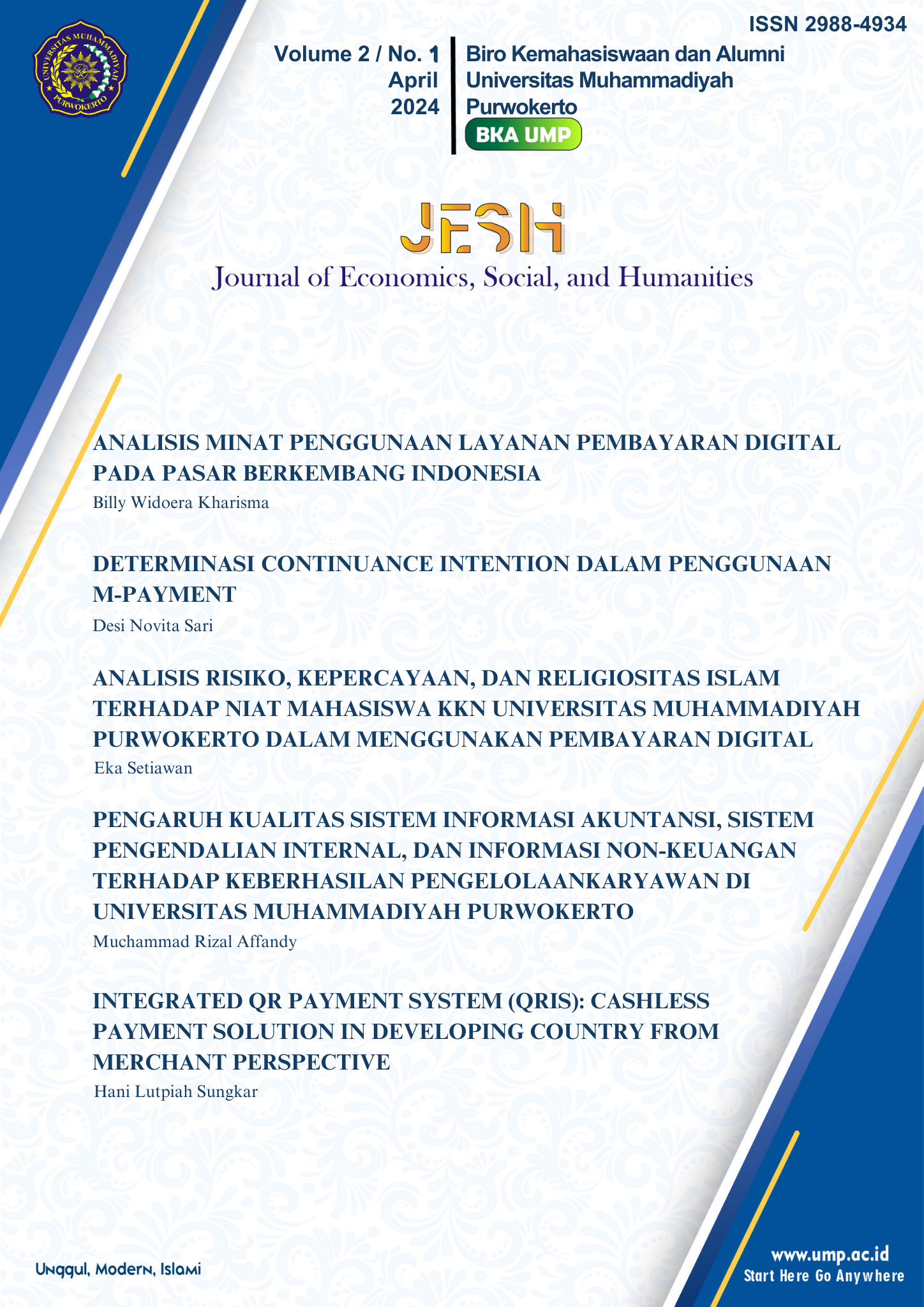
Pengaruh Kualitas Sistem Informasi Akuntansi, Sistem Pengendalian Internal, dan Informasi Non-Keuangan terhadap Keberhasilan Pengelolaan Karyawan di Universitas Muhammadiyah Purwokerto
DOI:
https://doi.org/10.30595/jesh.v2i1.309Keywords:
Sistem Informasi Akuntansi, Sistem Pengendalian Internal, Informasi Non- Keuangan, Keberhasilan Pengelolaan KaryawanAbstract
Keberhasilan pengelolaan karyawan dalam suatu organisasi sangat dipengaruhi oleh berbagai faktor, termasuk kualitas sistem informasi yang digunakan untuk mendukung proses pengambilan keputusan. Penelitian ini bertujuan untuk menganalisis pengaruh kualitas Sistem Informasi Akuntansi (SIA), Sistem Pengendalian Internal (SPI), dan kualitas Informasi Non- Keuangan terhadap keberhasilan pengelolaan karyawan di Universitas Muhammadiyah Purwokerto (UMP). Pendekatan kuantitatif digunakan dalam penelitian ini, dengan data yang dikumpulkan melalui survei kepada karyawan UMP. Variabel independen dalam penelitian ini adalah kualitas SIA, SPI, dan Informasi Non-Keuangan, sementara variabel dependen adalah keberhasilan pengelolaan karyawan yang diukur melalui indikator efektivitas kerja, produktivitas, dan kepuasan karyawan. Hasil penelitian menunjukkan bahwa kualitas SIA memiliki pengaruh signifikan terhadap keberhasilan pengelolaan karyawan, khususnya dalam aspek penyediaan data yang akurat dan relevan untuk perencanaan dan evaluasi kinerja. Sistem Pengendalian Internal juga ditemukan berkontribusi positif terhadap keberhasilan pengelolaan melalui peningkatan transparansi dan akuntabilitas dalam proses pengelolaan sumber daya manusia. Selain itu, kualitas Informasi Non-Keuangan, seperti data mengenai pelatihan, kompetensi, dan kepuasan kerja, memberikan dampak signifikan dalam mendukung pengambilan keputusan yang lebih tepat terkait pengelolaan karyawan. Penelitian ini menegaskan pentingnya integrasi kualitas sistem informasi dan pengendalian internal dalam meningkatkan keberhasilan pengelolaan karyawan di institusi pendidikan. Rekomendasi praktis yang dihasilkan mencakup peningkatan kualitas sistem informasi melalui pembaruan teknologi, penguatan pengendalian internal, dan optimalisasi pemanfaatan informasi non- keuangan untuk mendukung strategi pengelolaan sumber daya manusia yang lebih efektif
References
Adedeji, A., & Hannah, O. (2018). Effect of Internal Control System on Employee Performance of Small-Scale Manufacturing Enterprises in Ondo State, Nigeria. Human Resource Research, 2, 48. https://doi.org/10.5296/hrr.v2i1.13016
Alhidayatullah, A., Sudarma, A., & Amal, M. K. (2023). Efektivitas Pelatihan Kerja Dalam Meningkatkan Prestasi Kerja Karyawan. Coopetition : Jurnal Ilmiah Manajemen. https://api.semanticscholar.org/CorpusID:269435550
Ardiyanti, E., Nurwijayanti, & Wardani, R. (2023). Analysis of Leadership Internal Control and Employee Commitment on Employee Performance. Babali Nursing Research, 4, 552–560. https://doi.org/10.37363/bnr.2023.44277
Becker, E., & Huselid, M. (1998). High performance work systems and firm performance: A synthesis of research and managerial implications. Research in Personnel and Human Resource Management, 16, 53–101.
Collins, D. B., & Holton III, E. F. (2004). The Effectiveness of Managerial Leadership Development Programs: A Meta-Analysis of Studies from 1982 to 2001. In Human Resource Development Quarterly (Vol. 15, Issue 2, pp. 217–248). John Wiley & Sons. https://doi.org/10.1002/hrdq.1099
Darmawan, D., & Darmawan, A. B. (2022). PENCAPAIAN EFEKTIVITAS KERJA MELALUI OPTIMALISASI KECERDASAN EMOSIONAL DAN PEMBERIAN BEBAN KERJA SECARA TEPAT KEPADA KARYAWAN. Jurnal Baruna Horizon. https://api.semanticscholar.org/CorpusID:250378346
Dhone, M., & Sarwoko, E. (2022). Internal communication and employee performance: The mediating role of motivation. Jurnal Ekonomi Modernisasi, 18, 255–263. https://doi.org/10.21067/jem.v18i2.6709
Hair, J., Sarstedt, M., Hopkins, L., & Kuppelwieser, V. (2014). Partial Least Squares
Structural Equation Modeling (PLS-SEM): An Emerging Tool for Business Research. European Business Review, 26, 106–121. https://doi.org/10.1108/EBR-10-2013-0128
Haq, S., & Novitasari, D. (2022). Eksplorasi Peran Variabel Kontekstual dan Mediasi
Kepuasan Kerja terhadap Perilaku Inovasi Karyawan. Edumaspul: Jurnal Pendidikan. https://api.semanticscholar.org/CorpusID:252084784
Harter, J. K., Schmidt, F. L., & Hayes, T. L. (2002). Business-unit-level relationship between employee satisfaction, employee engagement, and business outcomes: A meta-analysis. In Journal of Applied Psychology (Vol. 87, Issue 2, pp. 268–279). American Psychological Association. https://doi.org/10.1037/0021-9010.87.2.268
Irawati, I.-, Salju, S., & Hapid, H. (2019). PENGARUH PENGGUNAAN SISTEM INFORMASI MANAJEMEN TERHADAP KUALITAS LAPORAN KEUANGAN PADA PT. TELKOM KOTA PALOPO. Jurnal Manajemen STIE Muhammadiyah Palopo. https://api.semanticscholar.org/CorpusID:204622534
Kock, N. (2010). Using WarpPLS in E-collaboration Studies: An Overview of Five Main Analysis Steps. IJeC, 6, 1–11. https://doi.org/10.4018/jec.2010100101
Malik, M. A. R., Butt, A. N., & Choi, J. N. (2015). Rewards and employee creative
performance: Moderating effects of creative self‐efficacy, reward importance, and locus of control. In Journal of Organizational Behavior (Vol. 36, Issue 1, pp. 59–74). John Wiley & Sons. https://doi.org/10.1002/job.1943
Muliani, M., Usman, A., Bensaadi, I., & Nurhasanah, N. (2023). Pengaruh Pemahaman Akuntansi, Pemanfaatan Sistem Informasi Akuntansi, Penerapan Standar Akuntansi Pemerintah Dan Sistem Pengendalian Intern Terhadap Kualitas Laporan Keuangan Daerah Kabupaten Aceh Tengah. Jurnal Akuntansi Malikussaleh (JAM), 2(2), 168. https://doi.org/10.29103/jam.v2i2.11224
Noor, V. F., Ismail, T., Yulianto, A. S., Studi, P., Akuntansi, M., Ageng, U. S., & Serang, T. (2023). THE INFLUENCE OF INTERNAL CONTROL AND MANAGEMENT
CONTROL SYSTEM ( MCS ) ON EMPLOYEE PERFORMANCE WITH WORK COMMITMENT AS A. 3(9), 1593–1607.
Paramitha, A. A., & Dharmadiaksa, I. (2019). Pengaruh Kompetensi Karyawan dan Teknologi Informasi pada Kualitas Laporan Keuangan LPD Dengan Pendidikan Sebagai Pemoderasi. E-Jurnal Akuntansi, 682. https://doi.org/10.24843/EJA.2019.v26.i01.p25
Praja, R. A., Mardiana, T., & Pratiwi, K. W. (2023). The Influence of Human Resources Audit and Internal Control System on Employee Performance in PT . Subur Sedaya Maju Prabumulih. II(2), 115–128.
Pratiwi, L., & Dharmadiaksa, I. (2018). Pengaruh Pemanfaatan dan Relevansi Teknologi Informasi Serta Efektivitas Sistem Informasi Akuntansi Pada Kinerja Karyawan. E- Jurnal Akuntansi, 351. https://doi.org/10.24843/EJA.2018.v23.i01.p14
Putra, J. E., Fitrios, R., & Hanif, R. A. (2020). PENGARUH PENGGUNAAN TEKNOLOGI INFORMASI DAN KOMPETENSI PENGGUNA TERHADAP KUALITAS SISTEM INFORMASI AKUNTANSI, SERTA DAMPAKNYA PADA KUALITAS
INFORMASI AKUNTANSI. Jurnal Riset Akuntansi. https://api.semanticscholar.org/CorpusID:225969682
Rachmawati, R. (2016). Sistem Informasi Dilihat Dari Aspek Kualitas Informasi Akuntansi Manajemen. Jurnal Riset Akuntansi Dan Keuangan, 4(2), 985–992.
https://doi.org/10.17509/jrak.v4i2.4032
Riupassa, E., & Mauwa, M. (2023). Impact of Accounting Information Systems, Work Motivation, and Internal Controls on Employee Performance: A Study at PT. Bank Danamon, Ambon Branch. Journal of Corporate Governance, Insurance, and Risk Management, 10, 118–124. https://doi.org/10.56578/jcgirm100202
Sari, M., m.kamil, D., & Sagala, N. (2023). Determinants of employee performance at public hospitals in Indonesia: Examining the moderating role of organizational culture.
Problems and Perspectives in Management, 22, 57–68. https://doi.org/10.21511/ppm.22(1).2024.06
Shah, R., & Goldstein, S. M. (2006). Use of structural equation modeling in operations management research: Looking back and forward ☆. Journal of Operations
Management, 24, 148–169. https://api.semanticscholar.org/CorpusID:55449221
Sridarmaningrum, L., & Widhiyani, N. (2018). Pengaruh Efektivitas Sistem Informasi Akuntansi, Kesesuaian Tugas, Kenyamanan Fisik dan Lingkungan Kerja pada Kinerja Karyawan. E-Jurnal Akuntansi, 1955. https://doi.org/10.24843/EJA.2018.v23.i03.p13
Sukarana, M., & Machmury, A. (2022). Pengaruh Kompetensi SDM, Sistem Informasi Akuntansi, dan Teknologi Informasi Terhadap Kinerja Pengelolaan Devisa Keuangan Perhotelan di Bulukumba. JEKPEND: Jurnal Ekonomi Dan Pendidikan, 5(2), 35. https://doi.org/10.26858/jekpend.v5i2.33802
Wabang, S., & Batilmurik, R. (2023). Pengaruh Kualitas Layanan Internal Terhadap Kepuasan Kerja Pegawai pada Politeknik Negeri Kupang. Journal of Practical Management Studies, 1, 32–37. https://doi.org/10.61106/jpms.v1i1.5
Yuliana, E., & Fadhli, K. (2023). Pengaruh Kepuasan Kerja Dan Loyalitas Karyawan Terhadap Kinerja Karyawan Industri Tenun Dua Thermos. MARGIN ECO. https://api.semanticscholar.org/CorpusID:261688397
Downloads
Published
How to Cite
Issue
Section
License
Copyright (c) 2024 Muchammad Rizal Affandy , EditorJESHUMP

This work is licensed under a Creative Commons Attribution-NonCommercial 4.0 International License.
Authors who publish with this journal agree to the following terms:
Authors retain copyright and grant the journal right of first publication with the work simultaneously licensed under a Creative Commons Attribution License that allows others to share the work with an acknowledgement of the work's authorship and initial publication in this journal.
Authors are able to enter into separate, additional contractual arrangements for the non-exclusive distribution of the journal's published version of the work (e.g., post it to an institutional repository or publish it in a book), with an acknowledgement of its initial publication in this journal.
Authors are permitted and encouraged to post their work online (e.g., in institutional repositories or on their website) prior to and during the submission process, as it can lead to productive exchanges, as well as earlier and greater citation of published work (See The Effect of Open Access).

Journal of Social, Economics, and Humanities is licensed under a Creative Commons Attribution 4.0 International License.